


Mastering some basics will be of great help when placing your order. So, let's discover the characteristics and different types of drive wheel tyres available.
1. What is an agricultural drive wheel tyre?
Agricultural tyres dedicated to drive wheels are designed to equip the drive axles of tractors and other agricultural machinery. They are mounted at the rear on two-wheel drive tractors and at the front and rear on four-wheel drive tractors.
2. The different types of agricultural tyres for drive wheels
There are two main categories of agricultural tyres: radial tyres and diagonal tyres.
Radial tyres
Radial tyres have a structure reinforced by steel cables arranged perpendicularly to the tread. They offer better resistance to high loads, a long lifespan, and lower fuel consumption.
Diagonal tyres
Diagonal tyres, also known as conventional tyres, have a structure reinforced by steel cables arranged diagonally. They are generally less expensive than radial tyres but offer a shorter lifespan and lower performance compared to radials.
II. Choosing the best agricultural tyres for drive wheels
1. Selection criteria for agricultural drive wheel tyres
Here are the main criteria to consider when making your choice.
Type of terrain
For loose soils such as ploughed earth or sand, it is recommended to choose tyres with deep and aggressive treads to offer excellent grip and traction. These tyres generally have treads 45 to 60 mm deep. This significant depth allows for better grip on soft ground by facilitating the ejection of accumulated mud and preventing tyre overload and loss of traction.
On difficult terrains, however, it is preferable to use tyres with flat and rounded treads. This type of tread, with a typical depth of 20 mm to 30 mm, offers better protection against obstacles and punctures. Flatter treads also improve stability by increasing the contact surface with the ground, which better distributes the vehicle's weight and reduces slippage.
Usage conditions
For intensive fieldwork such as ploughing, sowing, or harvesting, opt for highly adhesive tyres with strong traction to transmit maximum power to the ground.
If the tractor is mainly used for road transport, then tyres with low rolling resistance will be more suitable to reduce fuel consumption.
In the case of mixed applications, choose versatile tyres offering a good compromise between grip, longevity, and low rolling resistance.
Load capacity
The maximum load capacity of the tyre, expressed in kg or lbs, depends on its outer diameter and construction (radial or diagonal).
For example, index 133 allows for a load of 2,060 kg per tyre, which is suitable for the rear wheels of a medium-power tractor.
Index 168 with a load of 5,600 kg per tyre is suitable for very large tractors or loaded agricultural trailers.
It is essential to respect the indicated load indices to avoid any risk of overload that could damage the tyres and result in fines during road checks.
Operating speed
Choose a tyre with a speed rating suitable for the intended usage conditions on the farm.
For a farmer, the typical operating speed is generally around 30 to 40 km/h. These relatively low speeds are suitable for usual farming conditions, where movements are mainly on fields and paths at moderate speeds.
However, for farmers doing a lot of road transport with their tractor alone, it is recommended to opt for tyres with a higher speed rating such as D (65 km/h) or E (70 km/h), which are more resistant to abrasion on paved roads.
2. How to read the marking of an agricultural tyre?
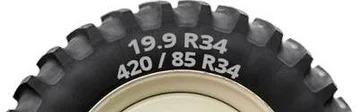
Now that you understand the basic selection criteria, here are our tips for reading the marking on agricultural tyres. All these elements inscribed on the sidewall are standardised inscriptions that identify the technical characteristics of the tyre, for example, "240/70 R16 104A8/101B".
Here is the complete list of the main markings that can appear on an agricultural tyre.
Dimensions
The size of an agricultural tyre is generally indicated by three numbers:
- Width in mm (e.g., 540)
- Height/width ratio in % (e.g., 65)
- Rim diameter in inches (e.g., 30)
Complete example: 540/65R30
Load and speed index
The load index indicates the maximum supported load. The speed index indicates the maximum allowed speed for the maximum load.
- Load index (e.g., 158) for the maximum load
Here are the most common load indices for the agricultural sector: 122: 1,500 kg - 133: 2,060 kg - 142: 2,650 kg - 149: 3,250 kg - 157: 4,125 kg - 168: 5,600 kg
- Speed index (e.g., A8 for 40 km/h)
Here are the most common speed codes for agricultural tyres: A6: 30 km/h - A8: 40 km/h - B: 50 km/h - D: 65 km/h
Structure and reinforcements
- TL: TL means "Tubeless" and specifies that a tyre is designed to be mounted directly on the rim without an inner tube.
- Letter R for radial structure
- IF or VF: Reinforced structure for more flexibility
- PR: Number of carcass plies (e.g., 4PR)
Regional specificities and approvals
The Top dimension
Other markings
- Model/range name
- Manufacturer's logo
- Specific mentions (e.g., 2S for heat resistance)
Let's take a practical example with the Petlas TA-110 model (240/70 R16 104A8/101B) and break down its marking:
- Dimensions 240/70R16 indicate a tyre 240 mm wide, with a height/width ratio of 70% and a rim diameter of 16 inches.
- Load index 104 corresponds to a maximum load of 900 kg per tyre when inflated to the recommended pressure.
- Speed index A8 indicates a maximum speed of 40 km/h under maximum load.
- Double marking 101B means that the tyre can also support a load of 825 kg at a speed of 50 km/h.
With these characteristics, the Petlas TA-110 is a versatile tyre suitable for medium-sized tractors used for mixed applications combining fieldwork and road transport.
3. Advantages of radial tyres compared to diagonal tyres
As we have seen above, these two types of tyres are frequently encountered. Here is a comparative table of the advantages, disadvantages, and applications of radial and diagonal agricultural tyres:
|
Criteria |
Radial Tyres |
Diagonal Tyres |
|
Advantages |
- Longevity and regular wear - Superior driving comfort - Optimised traction - Lower rolling resistance - Wider ground footprint - Reduced risk of de-beading at low pressure |
- Lower purchase cost - Excellent lateral stability - Resistant rigid sidewalls |
|
Disadvantages |
- High purchase cost - Sidewalls more sensitive to punctures - Lower lateral stability under heavy loads |
- Reduced comfort and shock transmission - Faster wear - Poorer traction and rolling resistance - Greater soil compaction |
|
Applications |
- Versatile main tractors - Road and field work - Soil and crop preservation |
- Earthmoving and construction work - Very rough or rocky terrains - Moderate budgets or occasional use |
4. Main brands of agricultural drive wheel tyres
The agricultural tyre market offers a variety of brands known for their quality. Here is a brief overview of some of them:
- Petlas is a Turkish brand specialising in the production of tyres for various applications, including agricultural.
- Tianli is a Chinese brand offering a range of tyres for agriculture, trucks, and construction machinery.
- Vredestein is a Dutch brand renowned for its high-quality tyres, including agricultural ones.
- Firestone is an iconic American brand, known for its robust and reliable tyres, particularly in the agricultural sector.
- Goodyear is a global tyre giant, offering a wide range of products, including high-performance agricultural tyres.
- Galaxy is an American brand specialising in tyres for agriculture and construction machinery.
- Cultor is a Finnish brand offering agricultural tyres suited to Nordic conditions.
- Bridgestone is a world-renowned Japanese manufacturer, offering superior quality agricultural tyres.
- Continental is a German brand known for its high-tech tyres, including in the agricultural field.
III. Use and maintenance of agricultural drive wheel tyres
This section provides the key steps for correct installation and effective maintenance.
1. How to install agricultural tyres?
Here are the main steps for installing tyres on your agricultural machinery :
- Check that the tyre dimensions match those recommended for your tractor/machine.
- Ensure that the rims are in good condition and free from deformations.
- Thoroughly clean the rims before mounting.
- Perform the mounting by strictly following the manufacturer's instructions (direction of rotation, positioning of beads, etc.).
- Inflate the tyres to the recommended pressure once the mounting is complete.
- Check the alignment and adjust the lead if necessary (see next section).
We recommend calling a professional for the mounting, especially for very large sizes.
2. Optimal maintenance to extend the life of agricultural tyres
To maximise the lifespan of your tyres, their maintenance can be summarised as follows :
- Regularly check the inflation pressure and adjust if necessary
- Check the tread wear and the absence of damage (cuts, cracks, etc.)
- Perform re-grooving if necessary to restore grip
- Clean the tyres after each use to avoid clogging
- Respect the recommended maximum loads and speeds
- Regularly adjust the alignment and lead
3. Average lifespan of agricultural tyres
As we have seen previously, the lifespan of an agricultural drive wheel tyre depends on many factors such as the type of tyre (radial or diagonal), usage conditions, maintenance, etc.
However, their average lifespan can be estimated as follows:
- Radial tyres : 5000 to 8,000 hours of use
- Diagonal tyres : 3000 to 5,000 hours of use
Well-maintained, some high-end radial tyres can reach 10,000 hours or more.
Our best tyres


Learn more
Learn more




Learn more
Learn more


Learn more
Learn more


Learn more
Learn more

Learn more
Learn more

Learn more
Learn more


Learn more
Learn more

FAQ
1. What are the best agricultural drive wheel tyres?
There is no universal best brand or model; the choice depends on your specific needs (type of soil, loads, speeds, etc.). However, high-end radials like Vredestein or Trelleborg generally offer the best performance.
2. How to choose agricultural drive wheel tyres?
The main criteria are the type of terrain, usage conditions, loads, speeds, type of machine, and your budget. Radials are recommended in most cases.
3. What are the advantages of radial agricultural tyres compared to diagonal tyres for drive wheels?
Radials offer better load resistance, longer lifespan, lower fuel consumption, more grip, and comfort.
4. What is the average lifespan of agricultural drive wheel tyres?
On average, 5,000 to 8,000 hours for radial tyres, and 3,000 to 5,000 hours for diagonals. But this varies depending on usage and maintenance.
5. How to maintain agricultural tyres to extend their lifespan?
Regularly check and adjust the pressure, check wear, perform re-grooving if necessary, clean after use, respect maximum loads and speeds, adjust alignment and lead.