


Handling equipment, such as forklifts, pallet trucks, fork trucks, and tow tractors, are essential tools in various industrial and logistics sectors. Their role is to move materials and goods. However, these machines cannot operate optimally without tyres suited to their demanding conditions of use.
Industrial handling tyres are typically designed for these uses. They offer increased resistance to heavy loads, rough surfaces, and, in some cases, hostile environments. Their robust design allows them to withstand heavy stresses, thereby reducing the risks of premature wear, punctures, and accidents.
Indoor Environments (warehouses, factories)
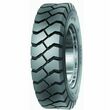
Forklifts used in indoor environments such as warehouses and factories are generally equipped with smooth or treaded tyres. Smooth tyres are ideal for hard and flat surfaces, offering good wear resistance. Treaded tyres, with their deep grooves, provide better grip on slippery or uneven surfaces, which is suitable for wet or dusty environments.
Pallet trucks, for example, are often fitted with smooth tyres, which are perfect for use in warehouses and storage areas.
Outdoor Environments (construction sites, quarries)
For outdoor environments such as construction sites and quarries, all-terrain forklifts are equipped with all-terrain tyres. These tyres have an aggressive tread pattern that allows for optimal traction on rough and muddy terrains, ensuring grip and high stability.
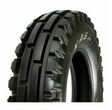
Handling tractors used in these outdoor environments are also equipped with all-terrain tyres or, in particularly challenging conditions, studded tyres. The latter are fitted with metal studs that offer maximum grip on slippery or snowy surfaces.
Specialised Environments
In some specialised environments, specific tyres are necessary. For example, forklifts used in hazardous areas may be equipped with reinforced puncture-proof tyres to withstand punctures caused by sharp debris. In areas where there is a risk of sparks or explosions, anti-static tyres are used to dissipate electrostatic charges.
Construction machinery such as excavators, loaders, and graders are generally equipped with reinforced tyres, with a high load capacity to support heavy loads and rough terrains.
Main Types of Handling Tyres
There are three main families of industrial handling tyres: solid tyres, radial tyres, and bias-ply tyres.
Solid Tyres
Without an inner tube, solid monobloc rubber or elastomer tyres are resistant to punctures and damage. Their rigid inner core provides great stability, while the soft rubber tread ensures good ground grip. The rubber compounds vary to meet specific needs such as anti-skid. Solid tyres are available in smooth or treaded versions.
Their distinctive advantage lies in their total insensitivity to foreign, sharp, or piercing objects.
Radial Tyres
The radial structure of industrial and handling tyres, with its plies perpendicular to the direction of travel, offers great stability. Their inextensible belt made of metal or textile cables ensures a smooth ride and long lifespan.
The flexible and supple sidewalls provide excellent ride comfort and good shock absorption. The optimised tread pattern promotes grip and efficient debris evacuation. The different rubber compositions are adapted to heat or abrasion exposure.
An advantage of radial tyres is their low rolling resistance, which translates to reduced fuel consumption.
Bias-Ply Tyres
The cross-ply structure at approximately 55° to the tread gives bias-ply tyres great strength and excellent road holding. The belt, made of flexible cables, acts as an effective shock absorber.
It absorbs shocks and vibrations from the road, ensuring a comfortable ride and increased tyre longevity. The reinforced sidewalls provide additional resistance to potential damage. Their rigidity protects the tyre from side impacts, snags, and deformations.
The advantage of bias-ply tyres lies in their remarkable longevity and their ability to withstand high traction.
How to Choose Industrial Handling Tyres?
Now that you know more about handling tyres, let's move on to the technical part of this guide. Below, we provide all the information to identify the model that best suits your needs.
Factors to Consider
Several factors must be considered when choosing handling tyres:
- Load: Ensure that the tyres can support the maximum load of your equipment, including the payload. Tyres generally have a nominal load capacity ranging from 2 to 12 tonnes depending on their construction and dimensions.
- Surface: Tyres must be suited to the surfaces on which they will be used. For example, deep-tread tyres are better suited for rough surfaces, while smooth tyres are recommended for concrete and asphalt.
- Environment: Consider the conditions of use, such as temperature (typical range of -30°C to +60°C ), humidity, the presence of debris or chemicals that could damage the tyres.
- Speed: If your equipment needs to move at high speeds, opt for tyres designed for better high-speed performance, up to 40 km/h maximum .
- Dimensions: Check the appropriate dimensions (width, rim diameter, sidewall height) based on the size and weight of your forklift or machine.
- Inflation Pressure: Adhere to the recommended pressure ranges, commonly between 6 and 10 bars for pneumatic tyres, to optimise grip, comfort, and lifespan.
- Traction Capacity: For applications requiring high traction, choose tyres with suitable tread patterns and rubber compositions.
How to read markings on industrial handling tyres?
Industrial handling tyres have markings on their sidewalls that provide information about their characteristics and capabilities.
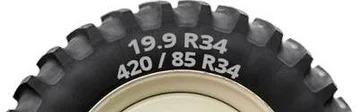
A typical marking on an industrial handling tyre might look like this: 8.25R15 14PR.
Here is what these different elements mean:
- 8.25 : This number indicates the tyre's section width in inches.
- R : The letter "R" means that the tyre has a radial construction.
- 15 : This number represents the rim diameter in inches on which the tyre should be mounted.
- 14PR : "Ply Rating", indicating the number of carcass plies, here 14 plies. The load index 14 corresponds to a maximum load of 775 kg per tyre.
This type of tyre 8.25R15 14PR is therefore a radial tyre with a width of 210 mm, mounted on a 15-inch diameter rim, with a high load capacity of 775 kg thanks to its 14 reinforcement plies.
Other common markings on industrial tyres include:
- Maximum speed : Common speed ratings for handling equipment tyres are generally low, as these machines operate at low speeds. Here are the most common speed ratings: A8 = 40 km/h and B = 50 km/h
- Special symbols : Symbols like "M+S" (mud and snow), "IND" (industrial use), or date of manufacture codes.
Top dimension
Maintenance and upkeep of industrial tyres
Regular maintenance of industrial handling tyres will enhance operator safety and extend their lifespan.
Importance of regular maintenance for safety and longevity
On one hand, poorly maintained tyres can have hidden defects such as uneven wear, cuts, or deformations that compromise their grip and road holding. This increases the risk of skidding, loss of control, or equipment overturning.
On the other hand, by periodically checking the pressure, sidewall condition, and tread, and performing recommended rotations, premature wear is avoided. Tyres can thus last much longer before reaching replacement criteria, resulting in substantial savings. Conversely, neglecting maintenance inevitably leads to more frequent tyre changes, incurring high recurring costs.
Checks to perform
Here are the main points to check, along with associated tolerances and regulations :
- Pressure : Check and adjust the air pressure of pneumatic tyres according to the manufacturer's recommendations, generally between 6 and 10 bars. Under-inflation or over-inflation by more than 20% compared to the recommended pressure can lead to premature wear and safety risks.
- Wear : Inspect the tread and sidewalls of the tyres and detect any excessive or irregular wear. The legal minimum tread depth is 1.6 mm for handling tyres. Replace tyres when the depth reaches this limit.
- Damage : Look for cuts, cracks, bulges, or other damage that could compromise the tyre's integrity. According to the standard EN 16804 , any damage exceeding 25% of the tread depth or affecting the carcass cables requires immediate replacement.
- Deformations : Check for abnormal deformations of the tread or sidewalls, which may indicate alignment, suspension, or overload issues.
- Tyre age : Note the date of manufacture (usually coded on the sidewall) and replace tyres after 5 to 7 years of use , even if they appear in good condition, as rubber aging can weaken them.
Our best tyres




Learn more
Learn more





Learn more
Learn more

Learn more
Learn more

Learn more
Learn more

Learn more
Learn more
FAQ on industrial handling tyres
What is the typical lifespan of an industrial tyre?
Solid tyres can reach 10,000 hours of use or more. Their airless design makes them virtually puncture-proof.
Bias tyres have a shorter lifespan than radials due to their more flexible construction and higher rolling resistance.
Radial tyres typically have a 30 to 40% longer lifespan than bias tyres.
Otherwise, a general rule of thumb is that the maximum lifespan of a tyre (all types combined) is about 10 years , even if it appears in good condition. Beyond that, material aging significantly reduces performance.
When to replace industrial tyres for handling equipment?
It is recommended to replace your industrial tyres when the tread depth reaches the minimum wear level indicated by the manufacturer, or when you notice significant damage (deep cuts, cracks, bulges, etc.).
Manufacturers usually indicate a minimum depth, often around 2 to 4 mm depending on the type of tyre. Irregular wear can also be a sign that replacement is necessary.
What are the risks of driving with worn tyres?
Driving with worn or damaged industrial handling tyres can lead to risks such as:
- Loss of grip and vehicle control
- Increased risk of accidents and injuries
- Damage to equipment and transported loads
- Higher operating costs (fuel consumption, premature wear, etc.)
Whether for indoor or outdoor environments, there is a wide range of solid, radial, or bias tyres designed to meet your specific needs. By considering key factors such as load, surface, environment, and speed, you can identify the tyres best suited to your uses.
Remember that regular tyre maintenance, with pressure, wear, and potential damage checks, is essential to maximize their lifespan and ensure safe and cost-effective operations in the long term.